Why should I care about drainage in my wall system? Moisture is the #1 cause of exterior wall damage in buildings. And drainage is a key design element that helps to remove water in walls. Trapped moisture can lead to paint/stain failure, mold, deterioration of building materials, and even structural damage. Where can I buy HydroGap Drainable Housewrap? HydroGap is available nationally through a network of authorized dealers. Contact our Customer Service team to find a distributor near you at 800-346-7655. What is the price of HydroGap Drainable Housewrap? Pricing varies regionally, but on average, HydroGap is 17-20 cents per SF. Please refer to your local dealer for an exact quote. Why do you onlu offer a 5ft roll? A 5ft wide roll provides for an easy, 1-man installation. More roll sizes may become available in the future. Why is the roll length only 100ft? To keep the roll weight and size manageable for a 1-man installation, 100ft (17lbs) is an ideal size. How much coverage does one roll of HydroGap provide? 500 SF How many rolls are on a pallet? 52 rolls/pallet What kind of cladding can I use with HydroGap Drainable Housewrap? Fiber Cement, Wood, Vinyl, 3-coat Stucco, Stone Veneer/Manufactured Stone, Metal What kind of fasteners should I use to install HydroGap? Similar to a standard housewrap, a hammer-tacker and staples are appropriate installation tools for HydroGap. If you are air-sealing from the exterior, cap fasteners must be used. Does HydroGap Drainable Housewrap have a warranty? Why is your perm rating only 16? Is a higher perm rating better? Many building scientists have provided research indicating that the ideal vapor permeability rating is between 10 and 20. The vapor permeability of HydroGap was specifically engineered to fall into this range. Permeability ratings within this range are suitable for most climates. For more detailed information on vapor permeability, please reference our white paper, “Understanding Housewraps: A Decision Guide for Selecting the Right Housewrap” found at benjaminobdyke.com What are those blue spacers made of? The blue spacers bonded to the housewrap are made of a blended thermoplastic polyolefin (TPO) material. What is TPO? TPO is short for thermoplastic polyolefin. TPO is more commonly recognized for its application in commercial roofing – the material is known for its exceptional resistance to UV and weathering conditions. What's a "tri-laminate" substrate? The tri-laminate substrate of HydroGap is comprised of 3 layers, including two non-woven layers with a vapor permeable, water-resistant film sandwiched between them. The tri-laminate not only offers great tear strength, but it also protects the water-resistant film between the outer layers. This unique structure prevents the film from being compromised during installation. What's the difference between a woven and nonwoven housewrap? Wovens and nonwovens are two different approaches to creating a fabric material, which can be used in the manufacture of housewrap. The key difference between a woven and nonwoven housewrap is the method in which vapor permeability is achieved. Woven housewraps tend to require micro-perforations to allow vapor permeability, whereas nonwovens do not. This is important because micro-perforations can decrease the water resistance of a housewrap. What is the difference between HydroGap Drainable Housewrap and Home Slicker Rainscreen? The main difference between HydroGap Drainable Housewrap and Home Slicker rainscreen is the size of the gap that each provides. Home Slicker is a true rainscreen, meaning that it provides a ¼-inch gap between the sheathing and the cladding. This ¼-inch gap provides for both drainage AND continuous airflow (drying). Home Slicker by itself does not act as a WRB (water-resistive barrier), so it needs to be installed along with a WRB (building paper, housewrap). We also offer a combination product, Home Slicker Plus Typar, that offers both a rainscreen and WRB in one product. Home Slicker is recommended as best practice in areas with wind-driven rain, especially when using water-absorptive claddings such as fiber cement and wood.
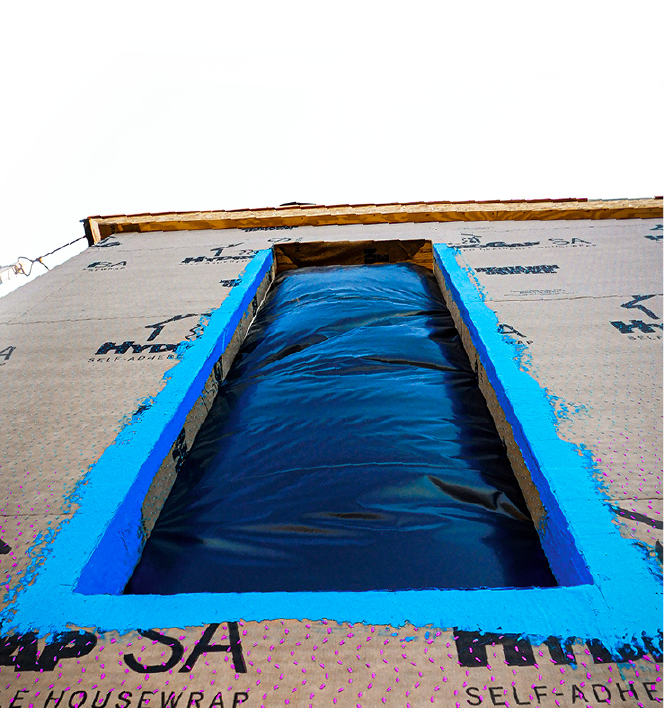
HydroGap Drainable Housewrap provides a 1mm gap between the sheathing and the cladding. This 1mm gap is not considered a rainscreen, as it provides drainage but not drying. HydroGap does act as a WRB, and meets all testing requirements for housewraps. The use of HydroGap Drainable Housewrap is recommended behind cladding types such as wood, fiber cement, vinyl, and stone & stucco. It’s also recommended in cases where budgets do not allow the use of a full rainscreen system such as Home Slicker. The installation instructions say that taping seams and using cap fasteners are optional with HydroGap. Why is that? If you are not using HydroGap as a primary air-barrier, you do not need to tape vertical or horizontal seams or use cap-fasteners as long as you install with the appropriate overlaps per the installation instructions (4” min. on horizontal, 6” min. on vertical, 12” min. around corners). Because the 1mm gap of HydroGap provides a drainage path for intruding water, the water will follow the path of least resistance, draining out of the system versus migrating up and/or across and penetrating seams. Taping and appropriate flashing are still required around windows and other penetrations; however, taping seams is not necessary.
If you are attempting to use HydroGap as a primary air-barrier, seams will need to be taped. Cap-fasteners will also need to be used to accomplish this. Also, it’s necessary to seal every penetrable area, as well as the sill plate, in order to achieve a true air barrier from the exterior. If I want to tape, what brand do you recommend? Benjamin Obdyke offers a specially-formulated, 2-7/8” wide tape for HydroGap called HydroTape™. You can also use other brands of tape, but a tape at least 2-1/2” wide is recommended. A wide tape provides more surface area for adhesion between the housewrap and the tape. Can I use HydroGap Drainable Housewrap in a stone or stucco application? Yes -- HydroGap can be used with any cladding material, including stucco and stone. HydroGap has been evaluated as an approved moisture drainage system for use in stucco and adhered masonry veneer wall systems (recognized according to the Exception to IRC Section 703.6.3). From an application standpoint, we recommend that HydroGap be used as the first WRB layer, with a secondary intervening layer between the housewrap and the scratch coat. Installation drawings are available at www.hydrogap.com. Can I use HydroGap Drainable Housewrap in an EIFS application? Yes -- HydroGap can be part of a sustainable EIFS assembly. Within the EIFS market, moisture-managed systems have grown in popularity. HydroGap can serve as the means of drainage that is typically located behind the foam board. Installation drawings are available at www.hydrogap.com. Can I use HydroGap Drainable Housewrap in an exterior insulation board application? Yes -- HydroGap will provide an effective drainage space in the wall assembly when using exterior insulation board. The prduct can be applied either behind the insulation board (for drainage between the board and sheathing), or on top of the insulation board (for drainage directly behind the cladding). Installation drawings are available on www.hydrogap.com. Please contact our technical service team for guidance on your project: 800-346-7655 or techsupport@benjaminobdyke.com. Can I use HydroGap Drainable Housewrap as a membrane or underlayment in roofing applications? We do not recommend the use of HydroGap as a membrane or underlayment in roofing applications. We have not tested the product for use in these types of applications. Can I use HydroGap Drainable Housewrap together with Home Slicker? You can install both products, however, there is no additional drainage performance added by combining them. The 1mm gap provided by HydroGap will be covered by the ¼” gap created by Home Slicker. If you prefer the housewrap performance characteristics of HydroGap over other brands due to its tear strength, perm rating, water resistance, and trilaminate substrate, then it can certainly be paired with Home Slicker to achieve an exterior rainscreen system. Can I get HydroGap customized with my company logo? Sorry, we cannot customize the printing of logos on HydroGap at this time. |
Join our Mailing List